Roofing Rules in Pennsylvania: What Philadelphia, PA Homeowners Should Know
Pennsylvania doesn't license roofers as a trade, yet it sets firm rules for home improvement contracts, and Philadelphia, PA adds its own permit and contractor license on top. Here is what a homeowner in the city or the nearby townships should check before a roofer starts. This is a summary of public law, not legal advice.
What Matters Most
Short on time? Start with these.
- Look the roofer up. Search its name on the Attorney General's online Home Improvement Contractor lookup before you sign.
- One permit, one City license. In Philadelphia, a new roof covering needs an L&I permit, and a contractor the City licenses must do the job.
- Put it in writing. Any home improvement contract over $500 has to be written and signed by you and the contractor.
- Three days to change your mind. You can back out within three business days after signing, no matter where the signing happened.
- A capped deposit. On jobs above $5,000, the down payment can't be more than one-third of the price, plus special-order materials.
One more point belongs here. Pennsylvania has no roofing-specific deductible law that this page cites, but the rule of thumb is simple: you pay your own deductible. If a contractor offers to cover or waive it while sending your insurer a bill for the full price, walk away. Giving an insurer false information about a claim is insurance fraud under state law.
What PA Requires of Roofers
There is no roofing license at the state level. Roofing falls under the broader heading of home improvement, and any contractor who does $5,000 or more of that work in a year must register with the Pennsylvania Attorney General and renew every two years. The contractor has to print its registration number on its own contracts and advertising. Before you sign anything, type the company's name into the Attorney General's Home Improvement Contractor search and confirm the details match the paperwork in front of you.
This site doesn't check, rank or vouch for any roofer, so that lookup is yours to do. It also prints no registration or license numbers.
Philadelphia adds a second layer. The Department of Licenses and Inspections (L&I) licenses contractors, and the City's building permit page puts it plainly: "A licensed Philadelphia contractor must perform the work." For an existing one- or two-family home, a contractor registered with the state may instead file that registration with L&I and hold a City Commercial Activity License. Ask the roofer which route it uses, and ask to see current liability insurance and workers' compensation coverage too.
Cancellation Rights
The state's home improvement law gives homeowners three business days to cancel a contract after signing it. That holds whether you signed at your kitchen table, at the contractor's office or anywhere else, and the contract itself has to explain how to cancel. If you do back out, send the notice the way the contract describes, keep a dated copy, and do it inside the window.
That right sits alongside a set of rules about the contract itself. Any home improvement job over $500 needs a written contract signed by both sides, and it must list:
- The registration number. The contractor's Pennsylvania home improvement registration, printed on the contract.
- The full price. The total amount you will pay for the work.
- The schedule. A start date and a finish date for the job.
- The work and the materials. A description of what will be done and what goes on the roof.
- Insurance amounts. The contractor's liability coverage and how much it carries.
- The cancel notice. A written explanation of your three-business-day right.
A contract that leaves out required parts may not be enforceable against the homeowner, so read every page before signing.
Money has rules of its own. No payment can be demanded before the contract is signed. On a contract above $5,000, the deposit is limited to one-third of the price, plus the cost of any special-order materials the contract names. If the plan changes partway through, the change order must also be in writing and signed by both of you. A roofer who wants cash only, or the whole price before work starts, is showing you a warning sign.
Local Permit Questions
Permits are local, and every municipality around the city runs its own office.
City of Philadelphia. Replacing a roof covering takes an L&I "EZ" permit, which needs no drawings and follows the City's EZ re-roofing standard. The roofer normally files it, so ask whose name is on the permit and ask to see it. Inside the city, reach L&I through 311.
Historic properties. If your building is on the Philadelphia Register of Historic Places, the Philadelphia Historical Commission must approve roof work before it starts. Commission staff handle most roof permits, but the review still has to happen first.
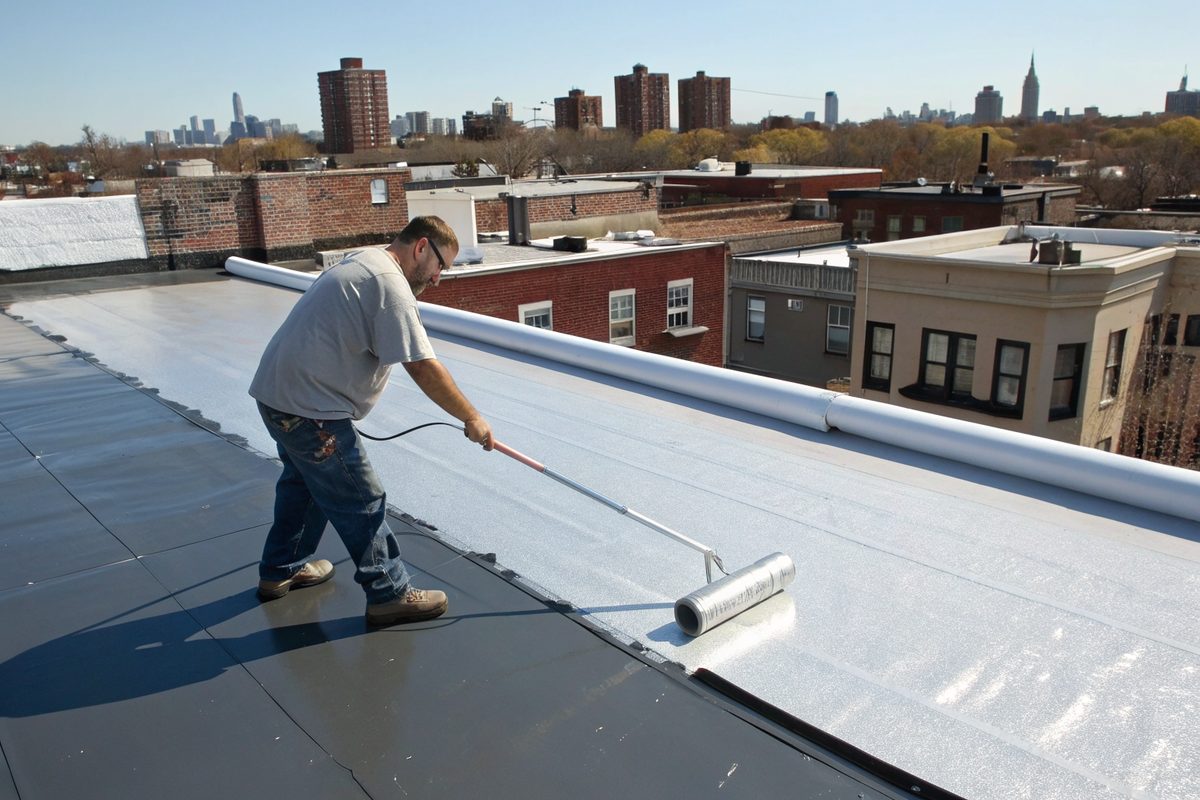
Flat rowhouse roofs. Most rowhouses have low-slope roofs that drain toward the back, covered in modified bitumen or EPDM, often under a silver or white coating; some have TPO. A coating alone is maintenance, not a replacement. Ask the roofer whether the membrane underneath is sound and what the permit covers.
The nearby townships each set their own rules, and none of them should be assumed to match the City's.
- Abington Township, PA (Montgomery County). "Roofing and siding permits are separate," and every contractor working in the township must register with it. Code Enforcement: 267-536-1000 ext. 4.
- Upper Dublin Township, PA (Montgomery County). The township issues reroofing permits, and a permit must be in hand before any work begins. Code Enforcement: 215-643-1600, extension 8070.
- Bensalem Township, PA (Bucks County). A residential reroofing permit appears on the township's fee schedule, and contractors register with the township every year. Building and Planning: 215-633-3644.
- Lower Merion Township, PA (Montgomery County). Each roofing permit application includes the township's roof permit addendum. The township allows "a maximum of two layers of shingles" and no overlay on slate, wood shake or tile. The roofer needs a township license or a Pennsylvania home improvement registration. Building & Planning: 610-645-6200.
- Upper Darby Township, PA (Delaware County). Roofing permits are on the township's fee ordinance, and residential contractors need a township contractor license as well as the state registration. Licenses & Inspections: 610-734-7613.
For ice-and-water shield and underlayment, ask the roofer.
Insurance Discounts for Stronger Roofs
Some insurers give a premium credit for impact-rated (Class 4) shingles. Each company decides whether it offers one and on what terms, so ask your own insurer before choosing a material, and get the answer in writing if it affects your choice.
The Fine Print, Asked
Can a roofer also handle my insurance claim as a public adjuster?
Public adjusters in Pennsylvania are licensed by the Pennsylvania Insurance Department, and a contractor can't serve as both the roofer and the public adjuster on the same job. A roofer can document damage and price the repair. The claim is settled between you and your insurer, or through a licensed public adjuster or attorney you hire.
Where can I complain about a roofer in Pennsylvania?
If a home improvement contractor treats you badly, file a complaint with the Bureau of Consumer Protection in the Pennsylvania Attorney General's office. Keep your contract, receipts, photos and messages to send along. Questions about your policy or how an insurer handled a claim go to the Pennsylvania Insurance Department instead.
Who is responsible for getting the permit?
The roofer usually files it, since Philadelphia expects permitted roof work to be done by a contractor the City licenses, and most townships work through their own permit offices. Settle this before signing: the contract should say who pulls the permit, and you should see it before the old roof comes off.
What if the contract is missing the cancel notice or the registration number?
Hold off on signing until it's fixed. Ask the roofer to add what's missing, then check the registration number against the Attorney General's online search. A complete contract protects you far better than a verbal promise to sort it out later.
Source List
Every source below was read on 2026-10-10.
- Home Improvement Consumer Protection Act, 73 P.S. § 517.1 et seq. Attorney General's copy: attorneygeneral.gov/wp-content/uploads/2018/01/Act_132_Home_Improvement.pdf
- Attorney General, Home Improvement Contractor registration. attorneygeneral.gov/home-improvement-contractor-registration/
- City of Philadelphia, EZ permits and building permits. phila.gov, "Get permits without plans (EZ permits)" and "Get a building permit"
- Philadelphia Historical Commission. phila.gov/departments/philadelphia-historical-commission/
- Township permit pages. abingtonpa.gov (residential applications and forms), upperdublin.net (Code Enforcement trade permits), bensalempa.gov (fee schedule), lowermerion.org (roof permit application addendum), upperdarby.org (Licenses & Inspections).
Ask About Your Situation
If you are ready to get a real price, send a request through the form. This site is a free referral service, not a roofing company: it passes your details to one independent local roofer, who inspects the roof, writes the estimate and does any work you agree to. The roofing company pays the site a fee for each referral, and the homeowner pays nothing and receives nothing.